AI Coding tool profile
opencodex
opencodex is a local provider proxy that lets OpenAI Codex and Claude Code use routed models from Anthropic, Gemini, xAI, Kimi, Ollama, OpenRouter, DeepSeek, GLM, and other providers. It translates Codex Responses traffic and other provider formats while keeping the client workflow intact.
Independent research from official sources · Sources · How we review
- Best for
- Codex users who want to test or operate models beyond the native OpenAI route, and developers who want Codex, Claude Code, and related clients to share one locally managed provider and routing layer.
- Starting point
- Free and open source under the MIT license; install the local proxy from the published npm package or run...
- Free plan
- Yes — The proxy software is free and open source (MIT) when self-hosted.
- Key limitation
- It is a local proxy, not a model provider or a way to bypass upstream account requirements, quotas, enforcement, or billing.
Choose it if
Strongest for
Built for
Avoid it if
- Some routes use OAuth or account credentials and therefore create provider-policy, privacy, and account-security responsibilities; read current provider Terms of Service first.
- A working setup requires a compatible Codex client, Node.js 18+, the proxy configuration, and at least one provider account, API key, local model, or supported login.
- Model catalogs, adapters, package versions, and compatibility can change quickly; verify the official docs and run a small real task before adopting it for production work.
Free-plan suitability
The proxy software is free and open source (MIT) when self-hosted. It does not grant free access to OpenAI, Anthropic, or other providers; provider plans, API charges, quotas, and account rules still apply.
Pricing
Free and open source under the MIT license; install the local proxy from the published npm package or run the source repository. There is no stated hosted subscription in the official project materials. Connected model providers, API keys, OAuth accounts, and any upstream usage charges remain separate.
Verify the current plan, credits, output limits, and commercial terms before purchasing.
Run it 24/7 on your own server
opencodex runs on your own machine, so it stops answering when your laptop sleeps. A small Linux VPS with Docker keeps it online for scripts, agents and teammates, with a fixed monthly cost instead of per-token markup.
- Start with the smallest plan that runs Docker; upgrade only if you add users or local models.
- Keep the gateway bound to localhost or behind a firewall, and store provider keys as environment variables.
- Monthly billing lets you test before committing to a long term.
Some links are affiliate links. We may earn a commission if you buy through them. Payment never changes our rankings or editorial verdicts.
What opencodex does
- Local HTTP proxy with ocx and opencodex command aliases
- Codex CLI, App, SDK, Claude Code, Claude Desktop, and Grok Build integrations documented by the project
- Adapters for Anthropic Messages, Google Gemini, Azure, OpenAI Responses passthrough, and OpenAI-compatible Chat Completions endpoints
- Provider routing, combos, fallback, model catalog synchronization, and a local web dashboard
- Optional web-search and vision sidecars for routed models
- Reversible Codex configuration integration: official docs document ocx init and ocx stop/restore flows
Is it legit?
Who is behind opencodex, where it is based, and what is publicly known about its funding. Company details change — verify on the official site before committing.
- Company
- lidge-jun/opencodex (independent open-source project)
Evaluation guide
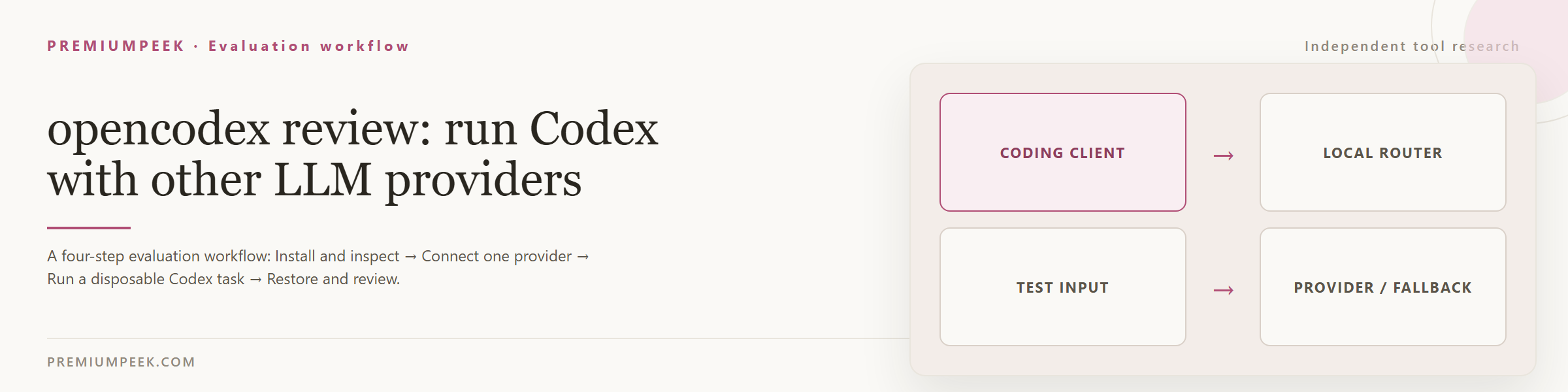
Step-by-step evaluation guides for opencodex — workflow fit, pricing, rights, and a same-input test before paying.
Compare opencodex with alternatives
Side-by-side pages that weigh opencodex against overlapping tools on the same five fields.
Official sources
These links are retained beside the catalog record so changing details can be rechecked.